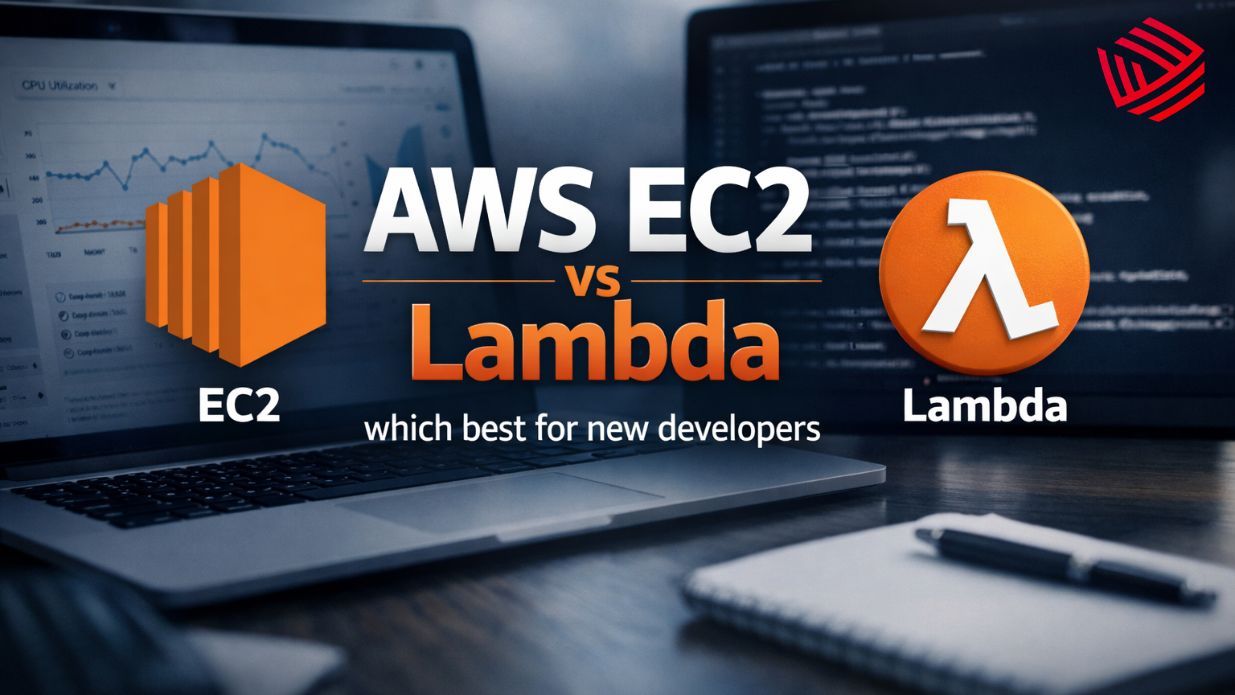
If you are a new developer in 2026 and trying to decide between AWS EC2 and AWS Lambda, you are not alone. Almost every beginner who starts learning cloud development reaches this exact confusion.
Should you manage your own virtual server?
Or should you let AWS handle everything and just run code?
Both options are powerful. Both are widely used. And both can help you build real-world applications.
But they are very different.
In this guide, I will explain everything in simple, clear language. No complicated terms. No unnecessary theory. Just practical advice based on real experience working with startups, student projects, and production systems.
By the end, you will clearly understand which one is better for you as a new developer—and why.
Understanding the Basics First
Before comparing them, let’s understand what they actually are.
What is AWS EC2?
Amazon EC2 (Elastic Compute Cloud) is a virtual server in the cloud.
Think of it like renting a computer from AWS. You choose:
- Operating system
- RAM
- CPU
- Storage
You install software, configure everything, and manage it just like a normal server.
You are in full control.
What is AWS Lambda?
AWS Lambda is a serverless compute service.
With Lambda:
- You upload your code
- AWS runs it when triggered
- You don’t manage servers
- You pay only when your code runs
No OS management. No patching. No scaling setup.
It feels almost magical when you use it for the first time.
The Real Question: What Does a New Developer Actually Need?
As a beginner, your priorities are usually:
- Learning how things work
- Building projects for resume
- Keeping costs low
- Avoiding unnecessary complexity
- Deploying something live
You don’t need enterprise-level architecture on day one.
You need clarity.
So let’s compare them properly.
Control vs Simplicity
This is the biggest difference.
EC2: Full Control
With EC2, you control everything:
- Server configuration
- Application setup
- Security groups
- File system
- Runtime versions
This is powerful. But it also means:
If something breaks, you fix it.
For learning DevOps basics, EC2 is amazing. You understand:
- How Linux works
- How to install Nginx or Apache
- How to configure Node.js or Java
- How to restart services
You become comfortable with servers.
That is valuable knowledge.
Lambda: Maximum Simplicity
With Lambda, you don’t see the server.
You just write code like:
- A function that handles API requests
- A function triggered by file upload
- A function triggered by database changes
AWS handles scaling automatically.
For beginners who want fast results, Lambda feels much easier.
You focus only on logic.
Cost Comparison for Beginners
Money matters—especially if you’re a student or new developer.
EC2 Pricing Reality
With EC2:
- You pay for server uptime
- Even if nobody visits your app
- Even if it’s idle
If you forget to shut it down, you still pay.
Yes, AWS free tier helps in the first year. But after that, costs can increase.
For example:
A small instance running 24/7 can cost monthly, even if traffic is very low.
Lambda Pricing Reality
Lambda charges:
- Per request
- Per execution time
If no one uses your app, you pay almost nothing.
For low-traffic beginner projects, Lambda is usually cheaper.
That’s a big advantage for students building portfolio projects.
Learning Perspective: Which Helps You Grow More?
Now this is important.
EC2 Teaches Infrastructure Basics
When you use EC2, you learn:
- SSH access
- Linux commands
- Web server setup
- Security configuration
- Firewall rules
These skills are very important for:
- DevOps roles
- Backend roles
- System engineering
If you want deep technical understanding, EC2 teaches you more about how things actually run.
Lambda Teaches Modern Cloud Thinking
With Lambda, you learn:
- Event-driven architecture
- Microservices design
- Serverless thinking
- Auto scaling concepts
- API Gateway integration
These are modern skills used in startups and cloud-native companies.
If you want to build scalable apps quickly, Lambda is powerful.
Deployment Experience: What Feels Easier?
Let’s talk honestly.
Deploying on EC2
Steps usually include:
- Launch instance
- Connect via SSH
- Install dependencies
- Configure environment
- Deploy app
- Set up reverse proxy
- Open ports
It takes time.
But you understand everything clearly.
Deploying on Lambda
Steps are often:
- Write function
- Upload code
- Connect to API Gateway
- Deploy
Much faster.
But sometimes debugging feels different because you don’t have direct server access.
Performance Differences
Many beginners worry about performance.
Here is the simple truth:
EC2
- Good for long-running applications
- Stable performance
- Ideal for heavy workloads
Lambda
- Excellent for short tasks
- Automatic scaling
- Has cold start delay (though much improved in 2026)
For normal beginner APIs, both are perfectly fine.
Real-World Example 1: Portfolio Website
Let’s say you build:
- React frontend
- Node.js backend API
If traffic is low:
Lambda is easier and cheaper.
If you want to practice server setup:
EC2 is better for learning.
Real-World Example 2: College Project
Suppose you create:
- Student management system
- MySQL database
- Backend API
If you want full-stack learning including database installation:
EC2 makes sense.
If you just want quick deployment without managing servers:
Lambda + managed database is simpler.
Real-World Example 3: Startup MVP
For a startup prototype:
- Traffic unpredictable
- Budget limited
- Need fast scaling
Lambda is usually better.
You don’t worry about scaling manually.
Debugging Experience
This is rarely discussed honestly.
EC2 Debugging
You can:
- Check logs directly
- Restart services
- Install debugging tools
Feels very hands-on.
Lambda Debugging
You rely on:
- Cloud logs
- Monitoring dashboards
It’s powerful, but different.
Some beginners initially find Lambda debugging less intuitive.
Security Considerations
EC2 Security
You must:
- Configure firewall rules
- Secure SSH
- Install updates
- Manage patches
If you forget updates, you risk security issues.
Lambda Security
AWS manages:
- OS updates
- Infrastructure patches
- You mainly handle:
- IAM permissions
- Code security
For beginners, Lambda reduces risk of misconfiguration.
Scalability Differences
EC2 Scaling
You need:
- Load balancer
- Auto scaling group
- Configuration rules
It’s powerful but requires setup.
Lambda Scaling
It scales automatically.
If 1 user comes, it runs once.
If 1,000 users come, it scales instantly.
No manual setup.
For beginners building unpredictable traffic apps, Lambda feels stress-free.
When EC2 Is Better for New Developers
Choose EC2 if:
- You want to learn Linux deeply
- You want DevOps knowledge
- You need full system control
- You are practicing server management
It builds strong foundational skills.
When Lambda Is Better for New Developers
Choose Lambda if:
- You want quick deployment
- You want minimal infrastructure work
- You are building small APIs
- You want cost efficiency
It helps you build faster and focus on coding.
My Honest Recommendation in 2026
If you ask me directly:
Start with EC2 to understand servers.
Then move to Lambda to understand modern cloud architecture.
Why?
Because understanding infrastructure makes you a stronger developer.
But building serverless apps makes you future-ready.
Both skills together make you valuable.
Common Mistakes Beginners Make
- Choosing EC2 and forgetting to shut it down
- Choosing Lambda without understanding event triggers
- Ignoring IAM permissions
- Not monitoring usage costs
Avoid these, and you’ll be fine.
The Final Decision Framework
Ask yourself:
Do I want to learn how servers work internally?
→ Choose EC2.
Do I want to build and deploy fast with minimal setup?
→ Choose Lambda.
Do I want both strong fundamentals and modern skills?
→ Learn both step by step.
Conclusion
In 2026, both AWS EC2 and AWS Lambda are powerful tools.
For new developers, the choice is not about which is better universally. It’s about what you want to learn and build right now.
EC2 gives you deep control and strong infrastructure understanding.
Lambda gives you simplicity, scalability, and cost efficiency.
There is no wrong choice—only different learning paths.
Start small. Build projects. Experiment. Break things. Fix them.
That’s how real developers grow.