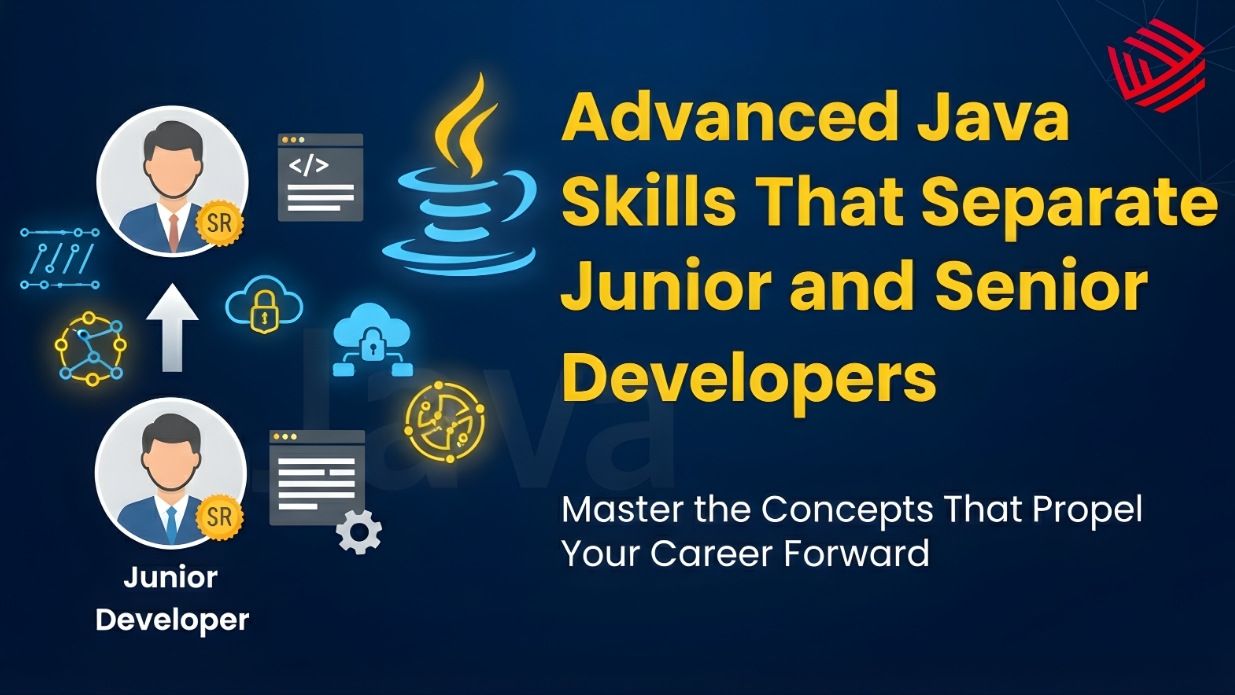
Java remains one of the most powerful and widely used programming languages in enterprise software, backend systems, and cloud-native applications. While many developers start their careers as junior Java developers by learning syntax and basic concepts, only a few successfully progress to senior-level roles. What truly differentiates them is not just experience, but advanced Java skills and deep knowledge of Java Frameworks that separate junior and senior developers.
Senior Java developers think beyond writing code. They understand system design, performance optimization, concurrency, memory management, security, and maintainability. They write code that scales, performs under pressure, and stands the test of time.
In this comprehensive guide, we’ll break down the advanced Java concepts for experienced developers, explain real-world use cases, and help you understand exactly what skills you need to move from junior to senior Java developer level.
Understanding the Core Difference Between Junior and Senior Java Developers
Before diving into technical skills, it’s important to understand the mindset shift.
Junior Java Developers Focus On:
- Writing functional code
- Following instructions
- Fixing bugs
- Learning syntax and frameworks
Senior Java Developers Focus On:
- Designing scalable systems
- Writing clean, maintainable code
- Optimizing performance
- Mentoring others
- Making architectural decisions
The difference lies not only in what they code, but how and why they code.
Deep Understanding of Java Core Concepts
Senior developers master Java fundamentals at a much deeper level.
Key Core Java Areas Senior Developers Master
- Object-Oriented Programming (OOP) principles
- Immutability and encapsulation
- Deep understanding of
equals()andhashCode() - Java memory model
- Garbage collection behavior
Example Insight
A junior developer knows what a HashMap is.
A senior developer knows how HashMap works internally, its time complexity, collision handling, and performance implications.
Mastery of Java Collections Framework
Advanced Java developers understand not just how to use collections, but when and why to use them.
Advanced Collection Skills Include:
- Choosing the right collection type
- Understanding internal data structures
- Performance trade-offs
- Thread-safe vs non-thread-safe collections
Examples
ArrayListvsLinkedListHashMapvsConcurrentHashMapTreeMapvsHashMapCopyOnWriteArrayListuse cases
Senior developers can justify every collection choice they make.
Concurrency and Multithreading Expertise
Concurrency is one of the most critical advanced Java skills.
Junior Developers Often:
- Use
synchronizedblindly - Avoid concurrency due to complexity
Senior Developers Understand:
- Java Thread lifecycle
- Race conditions and deadlocks
- Thread pools and executors
- Lock-free programming
- Atomic variables
Key Java Concurrency Tools
ExecutorServiceCompletableFutureForkJoinPoolvolatilekeywordReentrantLock
Efficient multithreading is essential in high-performance Java backend development.
In-Depth Knowledge of JVM and Memory Management
Senior Java developers understand what happens behind the scenes.
Advanced JVM Concepts
- Heap vs Stack memory
- Young vs Old generation
- Garbage collectors (G1, ZGC, CMS)
- Stop-the-world events
- Memory leaks and profiling
Why This Matters
Understanding JVM internals helps developers:
- Optimize application performance
- Diagnose memory leaks
- Reduce latency
- Improve scalability
This is one of the most important advanced Java skills that separate junior and senior developers.
Writing Clean, Maintainable, and Scalable Code
Senior developers prioritize code quality over speed.
Clean Code Practices
- Meaningful naming conventions
- SOLID principles
- Low coupling, high cohesion
- Proper exception handling
- Modular design
Code Maintainability Matters Because:
- Code lives longer than developers
- Teams grow and change
- Bugs become expensive over time
Senior developers write code that others can easily understand and extend, often collaborating closely with frontend teams that rely on layout systems such as Flexbox for Responsive Layouts to ensure smooth integration.
Design Patterns and Architectural Knowledge
Junior developers may know patterns by name. Senior developers know when to use them.
Essential Design Patterns for Senior Java Developers
- Singleton (with caveats)
- Factory and Abstract Factory
- Builder
- Strategy
- Observer
- Dependency Injection
Architectural Patterns
- Layered architecture
- Microservices architecture
- Event-driven systems
- Hexagonal architecture
Understanding architecture is a key factor in senior Java developer skills.
Advanced Exception Handling and Logging
Exception handling separates professional Java developers from beginners.
Senior-Level Exception Practices
- Custom exception hierarchy
- Meaningful error messages
- Avoiding exception swallowing
- Global exception handling
- Proper logging strategies
Logging Best Practices
- Log levels (INFO, WARN, ERROR)
- Structured logging
- Correlation IDs
- Avoiding sensitive data in logs
Well-handled exceptions improve reliability and debugging efficiency.
Performance Optimization and Profiling Skills
Senior Java developers know how to identify and fix bottlenecks.
Performance Optimization Skills
- Profiling CPU and memory usage
- Reducing object creation
- Optimizing database interactions
- Efficient caching strategies
- Asynchronous processing
Tools Senior Developers Use
- JVisualVM
- JProfiler
- Flight Recorder
- APM tools
Performance awareness is critical in enterprise-grade Java applications.
Advanced Java Framework Knowledge
Senior developers don’t just use frameworks—they understand them.
Common Frameworks Senior Developers Master
- Spring Boot internals and the Spring Boot framework lifecycle
- Hibernate/JPA performance tuning
- Transaction management
- Dependency injection lifecycle
- Security configurations
They know how frameworks work under the hood, not just annotations.
Strong Understanding of Databases and Transactions
Java backend developers must understand data deeply.
Senior-Level Database Skills
- SQL optimization
- Indexing strategies
- ACID properties
- Transaction isolation levels
- Handling distributed transactions
Database inefficiencies often cause major performance issues in Java applications.
Security Awareness in Java Applications
Security is often ignored by junior developers.
Senior Developers Understand:
- Secure authentication and authorization
- SQL injection prevention
- Secure password storage
- OWASP vulnerabilities
- Secure API design
Security-conscious coding is a hallmark of senior developers.
Testing, Debugging, and Code Reviews
Senior developers treat testing as a core responsibility.
Testing Skills Include:
- Unit testing with JUnit
- Mocking with Mockito
- Integration testing
- Test-driven development (TDD)
They also actively participate in code reviews, improving team-wide code quality.
Mentorship and Communication Skills
Technical skills alone don’t make a senior developer.
Senior Developers Also:
- Mentor junior developers
- Explain complex concepts clearly
- Participate in technical discussions
- Influence architectural decisions
Leadership and communication amplify technical expertise.
Common Mistakes Junior Developers Must Overcome
- Focusing only on frameworks
- Ignoring fundamentals
- Avoiding system design
- Writing unoptimized code
- Skipping testing
Overcoming these mistakes accelerates career growth.
Conclusion: Becoming a Senior Java Developer
The journey from junior to senior developer is not about writing more code—it’s about writing better code, making smarter decisions, and understanding systems holistically. Mastering these advanced Java skills that separate junior and senior developers will help you build scalable, secure, and high-performance applications.
Senior Java developers think long-term, prioritize quality, and continuously evolve with technology.
Call to Action
If you’re aiming to grow your Java career, start mastering these advanced skills today—or collaborate with experienced Java professionals to accelerate your journey toward senior-level expertise.
Frequently Asked Questions (FAQs)
What skills are required to become a senior Java developer?
Advanced Java concepts, JVM knowledge, concurrency, system design, performance optimization, and leadership skills are essential.
How many years does it take to become a senior Java developer?
Typically 4–7 years, depending on experience depth, learning speed, and project exposure.
Is Java still relevant for senior developers?
Yes. Java remains dominant in enterprise systems, fintech, cloud platforms, and backend services.
Do senior Java developers need framework expertise?
Yes, but they must understand frameworks deeply, not just use annotations.
Can self-learning make you a senior Java developer?
Yes, if combined with real-world projects, system design practice, and continuous learning.