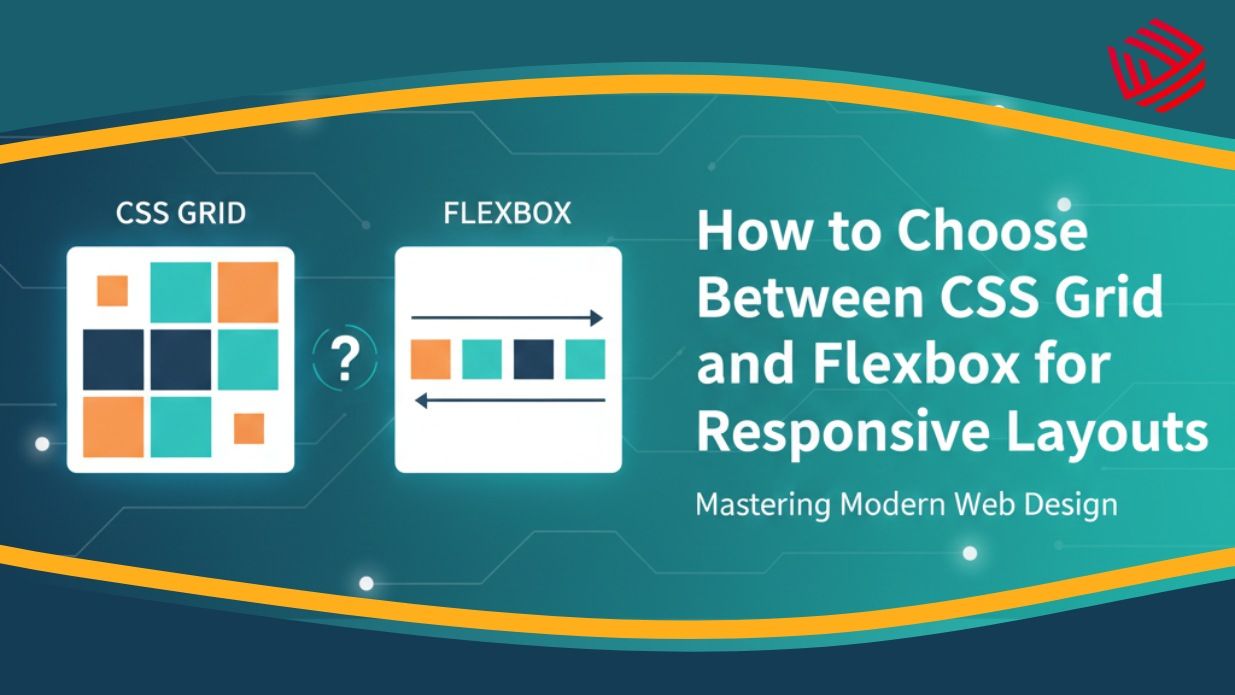
How to Choose Between CSS Grid and Flexbox for Responsive Layouts

How to Choose Between CSS Grid and Flexbox for Responsive Layouts

Responsive web design is no longer optional—it is the foundation of modern user experiences. With screens ranging from compact smartphones to ultra-wide monitors, developers need layout tools that adapt effortlessly. Among the most powerful solutions available today are CSS Grid and Flexbox, widely used by modern frontend teams including HTML5 Developers building scalable, standards-compliant interfaces.

Both are widely used, both are officially supported across modern browsers, and both solve layout problems—but they are not interchangeable. Choosing the wrong one can lead to unnecessary complexity, fragile layouts, and maintenance headaches that slow down teams trying to Speed Up Web Development.

This in-depth guide will help you clearly understand when to use CSS Grid, when Flexbox works better, and how to combine both intelligently for responsive layouts that scale gracefully and help teams Build Faster Web Apps.

Why Choosing the Right CSS Layout Method Matters

Layouts are more than visual arrangements. They directly affect:

  • Page readability
  • Content hierarchy
  • Performance
  • Maintainability
  • Mobile usability

A layout system that looks fine on desktop but breaks on mobile increases bounce rate and hurts SEO. Understanding Grid and Flexbox allows you to design with intent, not guesswork—an approach commonly adopted by experienced Tailwind CSS Developers working on utility-first design systems.

Understanding the Core Philosophy of Flexbox

Flexbox, short for Flexible Box Layout, is designed to manage one-dimensional layouts. That means it controls layout either in a row or a column—but not both at the same time.

What Flexbox Does Best

Flexbox shines when you need to:

  • Align items in a single direction
  • Distribute space dynamically
  • Handle content of unknown size
  • Reorder elements easily

It focuses on content-driven layouts, where elements adapt based on their size and available space.

Key Flexbox Concepts Explained Simply

Flexbox works around two axes:

  • Main axis (row or column)
  • Cross axis (perpendicular direction)

Key properties include:

  • display: flex
  • flex-direction
  • justify-content
  • align-items
  • flex-wrap

These properties allow flexible spacing and alignment without relying on floats or positioning hacks.

Real-World Use Cases for Flexbox

Flexbox is ideal for:

  • Navigation bars
  • Buttons with icons and text
  • Cards inside a horizontal scroll
  • Centering content vertically and horizontally
  • Toolbars and menus

If your layout flows in one direction, Flexbox is usually the cleanest solution.

Limitations of Flexbox You Should Know

While powerful, Flexbox has boundaries:

  • Not designed for full page layouts
  • Harder to manage complex grids
  • Alignment across rows is limited
  • Requires nesting for advanced structures

For large-scale layouts, Flexbox alone can become difficult to maintain.

Understanding the Core Philosophy of CSS Grid

CSS Grid is built for two-dimensional layouts, meaning it controls both rows and columns simultaneously.

Instead of arranging content based on items, Grid focuses on the layout structure first.

What Makes CSS Grid So Powerful

CSS Grid allows you to:

  • Define rows and columns explicitly
  • Place elements anywhere on the grid
  • Create complex layouts with minimal code
  • Maintain consistent spacing across breakpoints

It gives developers layout control without excessive nesting.

Essential CSS Grid Concepts Made Easy

Key Grid features include:

  • display: grid
  • grid-template-columns
  • grid-template-rows
  • grid-gap
  • grid-area

You can visually map your layout before placing content, making it ideal for structured designs.

Practical Use Cases for CSS Grid

CSS Grid works best for:

  • Page layouts
  • Dashboards
  • Image galleries
  • Blog post structures
  • Product listing pages

Any layout that requires both horizontal and vertical alignment benefits from Grid.

CSS Grid Limitations to Consider

Despite its strength, Grid may not always be the best choice:

  • Overkill for simple layouts
  • Learning curve for beginners
  • Less intuitive for content-driven alignment

For small UI components, Grid can add unnecessary complexity.

CSS Grid vs Flexbox: A Clear Comparison

AspectFlexboxCSS Grid
DimensionOne-dimensionalTwo-dimensional
Best ForComponentsLayouts
Content FlowContent-firstLayout-first
ComplexitySimple to moderateModerate to advanced
NestingOften requiredMinimal

This comparison highlights that neither is better universally—each excels in different situations.

How Responsive Design Changes the Decision

Responsive layouts are about adaptability, not just resizing.

Flexbox responds naturally to content changes, making it ideal for:

  • Dynamic elements
  • Variable text lengths
  • Small screens
  • CSS Grid excels at:
  • Rearranging layout sections
  • Maintaining visual balance
  • Managing breakpoints cleanly

Both approaches support performance-focused layouts that Reduce Frontend Load Time when used correctly.

When to Choose Flexbox for Responsive Layouts

Use Flexbox when:

  • Elements flow in one direction
  • Content size is unpredictable
  • You need quick alignment
  • Layout logic is simple

Examples include mobile menus, feature lists, and CTA sections.

When CSS Grid Is the Better Choice

Choose CSS Grid when:

  • Designing full page structures
  • Managing multiple content sections
  • Creating complex responsive grids
  • Reducing nested containers

Grid is perfect for modern websites with structured content.

Combining CSS Grid and Flexbox the Right Way

The most effective layouts often use both together.

A common strategy:

  • CSS Grid for page structure
  • Flexbox for internal components

This approach keeps layouts clean, readable, and scalable.

Example Strategy Without Code

  • Grid defines header, main content, sidebar, footer
  • Flexbox aligns items inside navigation and cards
  • Responsive changes handled through Grid areas
  • Flexbox manages spacing inside components

This combination mirrors how professional front-end teams work.

Performance and Maintainability Considerations

Both Grid and Flexbox are performant, but maintainability matters more long-term.

Grid improves maintainability by:

  • Reducing nesting
  • Clarifying layout intent
  • Simplifying breakpoint management

Flexbox improves maintainability for components by:

  • Adapting to content changes
  • Avoiding rigid sizing

Choosing correctly saves time and reduces bugs.

SEO and User Experience Impact

Layouts influence:

  • Content readability
  • Scannability
  • Mobile friendliness

Google favors pages where users can easily consume content. Clean layouts created with the right CSS method lower bounce rates and improve engagement.

Common Mistakes Developers Make

Avoid these pitfalls:

  • Using Flexbox for full page layouts
  • Forcing Grid for small components
  • Over-nesting containers

Ignoring layout intent

Understanding the purpose of each tool prevents these mistakes.

Future-Proofing Your Layout Choices

CSS Grid and Flexbox are both future-ready. However:

  • Grid continues evolving for layout systems
  • Flexbox remains essential for components

Learning when to use each ensures your designs remain adaptable.

Final Decision Guide (Quick Reference)

Ask yourself:

  • Is this layout one-directional? → Flexbox
  • Does it require rows and columns? → CSS Grid
  • Is it a component? → Flexbox
  • Is it a page structure? → CSS Grid

Clear answers lead to clean layouts.

Conclusion: Make Layout Decisions with Confidence

Choosing between CSS Grid and Flexbox is not about preference—it’s about purpose.

Flexbox simplifies alignment and content flow.
CSS Grid empowers structured, responsive layouts.

When used thoughtfully, they complement each other and elevate your design quality.

Mastering both gives you the confidence to build responsive websites that look great, perform well, and scale effortlessly.

More Blogs

ChatOps Tools to Enhance Developer Collaboration | Dappinity

ChatOps Tools to Enhance Developer Collaboration | Dappinity

ChatOps integrates chat platforms with DevOps workflows, enabling developers to collaborate and execute tasks directly from messaging tools. These tools improve communication, automate routine tasks, and reduce context switching. By connecting pipelines, monitoring systems, and incident management into chat, teams can respond faster and work more efficiently. Adopting ChatOps tools ensures transparency, better coordination, and streamlined collaboration for modern development teams.

by ankit 5 March 2025
Ensuring UI Consistency with Visual Regression Testing Tools | Dappinity

Ensuring UI Consistency with Visual Regression Testing Tools | Dappinity

Maintaining UI consistency is critical for delivering seamless user experiences. Visual regression testing tools help detect layout changes, broken designs, and unexpected UI shifts. By automating these checks, teams can ensure pixel-perfect web applications across browsers and devices. This reduces costly design errors, accelerates QA cycles, and improves overall product quality.

by ankit 5 March 2025
Top CI/CD Tools for Scalable Web Apps

Top CI/CD Tools for Scalable Web Apps

Read how CI/CD streamlines code integration, testing, and deployment—boosting speed, quality, and scalability in modern software development.

by varsha 5 March 2025
Top AI Tools for Database Query Optimization and Monitoring

Top AI Tools for Database Query Optimization and Monitoring

Database performance is critical for modern applications, and AI tools are making optimization faster and smarter. They provide predictive insights, automated query tuning, and real-time monitoring. From simple AI2SQL recommendations to enterprise-grade SolarWinds analysis, these tools reduce manual effort. Teams can now maintain high performance, avoid bottlenecks, and ensure reliable user experiences with AI-powered database solutions.

by manish 5 March 2025
Top Low-Code and No-Code Platforms to Watch in 2025

Top Low-Code and No-Code Platforms to Watch in 2025

Low-code and no-code (LCNC) platforms are reshaping application development, enabling both developers and non-technical users to build faster and smarter. By 2025, they’re vital for digital transformation across industries. With AI integration, enterprise adoption, and improved security, LCNC tools support innovation at scale. Choosing the right platform empowers businesses to reduce costs, improve agility, and stay competitive in a rapidly evolving market.

by manish 5 March 2025
How Analyzing Log Patterns Transforms Debugging and Monitoring

How Analyzing Log Patterns Transforms Debugging and Monitoring

Analyzing log patterns turns raw system data into actionable intelligence, enabling faster debugging and predictive monitoring. Instead of firefighting after failures, teams gain context, uncover root causes, and detect anomalies before they escalate. From error clustering to capacity planning, pattern analysis strengthens security, performance, and compliance. By leveraging AI-driven tools, businesses can transform logs into a proactive strategy for resilience and customer trust.

by varsha 5 March 2025
Top 5 Emerging Software Testing Roles Every Product Company Needs

Top 5 Emerging Software Testing Roles Every Product Company Needs

Discover the top 5 emerging software testing roles every product company needs, from AI testing engineers to QAOps specialists, and boost product quality.

by varsha 5 March 2025
Top AI Tools for Progressive Web App Performance Optimization

Top AI Tools for Progressive Web App Performance Optimization

Progressive Web Apps are expected to deliver app-like experiences at web scale, but optimizing performance can be complex. AI-powered tools provide automated monitoring, predictive insights, and actionable recommendations for load speed, caching, and responsiveness. By leveraging these tools, developers can ensure a seamless user experience while reducing manual tuning effort. The right AI solutions make PWAs faster, smarter, and more reliable.

by ankit 5 March 2025
AI Tools for Accelerating Developer Ramp-Up and Productivity

AI Tools for Accelerating Developer Ramp-Up and Productivity

Onboarding and ramping up new developers can be time-consuming, but AI tools simplify the process. From GitHub Copilot’s smart code suggestions to Sourcegraph’s intelligent code search, these platforms help developers understand codebases and workflows quickly. Tools like LinearB, Codex, and Tabnine further enhance productivity by automating routine tasks and providing real-time guidance. AI-powered ramp-up ensures faster integration, reduced errors, and higher team efficiency.

by manish 5 March 2025
AWS Developer vs AWS DevOps Engineer

AWS Developer vs AWS DevOps Engineer

Discover the real difference between an AWS Developer and an AWS DevOps Engineer in 2025. This in-depth guide explains roles, skills, certifications, AWS CI/CD pipelines, IaC tools, salaries, career paths, and how to choose the right certification—Developer Associate vs DevOps Professional—based on your goals. Perfect for beginners, students, job seekers, and professionals planning AWS careers in India, the US, and globally.

by ankit 5 March 2025
Testing dApps: Frameworks, Best Practices & Pitfalls

Testing dApps: Frameworks, Best Practices & Pitfalls

Discover how to test decentralized applications with the right frameworks, best practices, and security-focused testing strategies. This guide explains smart contract testing, performance checks, and common pitfalls to help you build reliable, scalable, and secure dApps that deliver a seamless Web3 experience.

by manish 5 March 2025
Top Tools Frontend Developers Use to Speed Up Web Development

Top Tools Frontend Developers Use to Speed Up Web Development

Discover the top tools frontend developers use to speed up web development, improve coding efficiency, simplify UI design, and deliver high-performance, modern websites faster than ever.

by varsha 5 March 2025
Top Platforms & Tools for Building Serverless and Containerized Applications in 2025

Top Platforms & Tools for Building Serverless and Containerized Applications in 2025

Modern software development has shifted from monolithic architectures to more agile approaches. Serverless applications remove infrastructure concerns, while containerized applications ensure consistency across environments. In 2025, top platforms like AWS Lambda, Kubernetes, and Docker lead the way in scalability and efficiency. Businesses can adopt either model — or a hybrid approach — to build flexible, cost-effective, and future-ready applications.

by manish 5 March 2025
Top Reverse Proxy Tools

Top Reverse Proxy Tools

A reverse proxy is a critical component in modern web infrastructure that sits between client devices and backend servers to manage, secure, and optimize traffic. It provides key functionalities such as load balancing, SSL termination, caching, security filtering, application firewalling (via WAF), global server load balancing, URL rewriting, rate limiting, and protocol translation. Reverse proxies enhance application performance, scalability, and security while simplifying authentication and traffic management. Popular tools like NGINX, HAProxy, Traefik, Envoy, and managed services like AWS ALB and Azure Gateway cater to various use cases—from microservices and containerized apps to enterprise-grade security. As architectures evolve, reverse proxies are becoming more intelligent, integrated into service meshes, edge-focused, and AI-enhanced for real-time traffic optimization and threat detection, making them indispensable for delivering reliable, scalable, and secure digital experiences.

by manish 5 March 2025
Best Application Performance Management Tools

Best Application Performance Management Tools

Application Performance Management (APM) tools give engineering and DevOps teams deep visibility into how applications behave in production — from user experiences to backend code and infrastructure. In a world of distributed, microservices-based environments, choosing the right APM platform is critical to detect issues early, optimise performance and maintain service reliability. This article highlights best APM solutions for 2025, outlines what to look for when selecting one, and offers practical guidance on successful adoption. Whether you run monoliths, containers or serverless stacks, the right APM tool becomes an investment in both technical excellence and business outcomes.

by manish 5 March 2025
Top GraphQL IDEs & Clients

Top GraphQL IDEs & Clients

GraphQL IDEs and clients have become essential tools in the modern API development lifecycle, offering powerful features for exploring, testing, visualizing, and monitoring GraphQL APIs. As the demand for flexible, schema-driven APIs grows, tools like GraphiQL, Apollo Studio, Postman, Insomnia, and others have emerged to support everything from query execution to performance observability and team collaboration. These platforms cater to a wide range of use cases—from solo developers and educators to large enterprise teams—by enhancing productivity, streamlining debugging, and promoting best practices. Looking ahead, advancements in AI, CI/CD integration, real-time collaboration, and security will continue to shape the future of GraphQL tooling.

by ankit 5 March 2025
Advanced Java Skills That Separate Junior and Senior Developers

Advanced Java Skills That Separate Junior and Senior Developers

This blog explains the advanced Java skills that truly separate junior and senior developers, covering core Java mastery, JVM internals, concurrency, system design, performance optimization, and real-world best practices needed to grow into a senior Java role.

by manish 5 March 2025
Top iOS Frameworks Every iPhone App Developer Should Know

Top iOS Frameworks Every iPhone App Developer Should Know

This blog explores the top iOS frameworks every iPhone app developer should know, including UIKit, SwiftUI, Core Data, AVFoundation, and ARKit. It explains how each framework supports performance, scalability, security, and modern app experiences, helping developers choose the right tools to build high-quality, future-ready iOS applications.

by varsha 5 March 2025
Top API Testing Tools For Developers

Top API Testing Tools For Developers

API testing verifies the functionality, security, and performance of backend services. It enables early bug detection, automation, and faster development. Tools like Postman, SoapUI, and JMeter help streamline and automate the process.

by ankit 5 March 2025
Top Feature Flag Platforms for Continuous Delivery Teams | Dappinity

Top Feature Flag Platforms for Continuous Delivery Teams | Dappinity

Feature flag platforms are key to decoupling code deployment from feature release, letting teams manage risk with gradual rollouts, A/B testing, and instant rollbacks. A good platform supports segmentation, observability, and tight integration with CI/CD. Tools like LaunchDarkly, Unleash, Flagsmith etc. offer varied trade-offs across pricing, ease of use, and capabilities. Choosing the right platform depends on factors like team size, infrastructure, regulatory needs, and experiment requirements.

by manish 5 March 2025
Top DevOps Tools Every Team Should Use

Top DevOps Tools Every Team Should Use

DevOps tools streamline software development by automating coding, testing, deployment, and monitoring, improving efficiency, collaboration, and security. Key tools like Jenkins, Docker, Kubernetes, Ansible, and Git enable faster releases, better infrastructure management, and consistent environments. Integrated security practices (DevSecOps) ensure early detection of vulnerabilities, while continuous monitoring and real-time feedback enhance software quality and resilience.

by ankit 5 March 2025
Top Tools and IDEs PHP Developers Use for Faster & Efficient Coding

Top Tools and IDEs PHP Developers Use for Faster & Efficient Coding

Discover the top tools and IDEs PHP developers use for faster, more efficient coding. Learn about editors, debugging tools, and workflow boosters to improve productivity and code quality.

by manish 5 March 2025
Top Server Monitoring Tools for NodeJS Apps

Top Server Monitoring Tools for NodeJS Apps

Monitoring is vital for Node.js apps to ensure uptime, performance, and reliability. From full-stack tools like New Relic and Datadog to lightweight options like PM2 and Netdata, the right solution depends on your app’s scale, team size, and budget.

by manish 5 March 2025
Top Observability Tools for Modern Cloud Applications | Dappinity

Top Observability Tools for Modern Cloud Applications | Dappinity

Observability is essential for modern cloud applications, combining metrics, logs, and traces for deep system insights. Enterprise platforms like Datadog, New Relic, and Dynatrace provide full-stack visibility and AI-powered analysis. Open-source tools such as Prometheus, Grafana, Jaeger, and OpenTelemetry offer flexibility for cloud-native environments. Specialized platforms like Honeycomb, PagerDuty, Moogsoft, and BigPanda enhance debugging, incident management, and proactive monitoring, ensuring reliability and optimized performance.

by manish 5 March 2025
Top SaaS Billing & Subscription Platforms: A Complete Guide

Top SaaS Billing & Subscription Platforms: A Complete Guide

SaaS billing and subscription management platforms are critical for automating the complexities of recurring revenue, enabling SaaS businesses to scale efficiently and enhance customer satisfaction. These tools go beyond simple invoicing by managing subscription lifecycles, automating payments, supporting global tax compliance, and reducing churn through smart dunning strategies.

by varsha 5 March 2025